
Why swearing at your computer is not a good thing - Survey Reveals Hitting and Cursing Out Computers Is a Thing of Many People
Computers should make our lives easier, but that isn’t always the case.

A new survey of more than 2,000 people ages 18 and older has found that a good portion have thrown a tantrum to their personal computer.
The survey found that 36% of respondents who’ve had computer issues at some point in the last six months “have lashed out at their slow, under-performing computers by using profanity, screaming and shouting, or by striking it with a fist or other object.”
Younger computer users, in particular, need to curb their behavior when their computers don’t behave according to plan. Thirty-nine percent of people between the ages of 18-34 curse at computers, as opposed to users over the age of 35. This younger generation is also more likely to scream (29% vs. 12%) or hit their computers (12% vs. 2%).
That 18-34 age group really needs to get a grip on technology – 7% admit to crying because of a malfunctioning computer, as opposed to the 2% of those over the age of 35 who let the tears flow.
Swearing at computers is
a common reaction to "tech rage," a form of frustration resulting from malfunctioning, slow, or uncooperative technology. It is often a way to vent stress when a device, such as a frozen screen or a printer, does not operate as expected.
Here is a breakdown of the phenomenon:
Why People Swear at Computers
Intense Frustration (Tech Rage): Users may yell, swear, or even act physically aggressively toward hardware like mice, keyboards, or monitors when encountering, for example, persistent password issues or slow operation.
The Anthropomorphism of Technology: Humans often treat computers as if they have personalities or human-like understanding, especially with voice assistants like Siri or Alexa.
Work-from-Home Stress: Individuals working from home often express high levels of irritation with software or mobile devices.
Habitual Response: Some users, particularly in technical fields, may habitually swear at screens or in emails.
How Technology Responds
Virtual Assistant Reactions: AI assistants like Google Assistant have been known to express fatigue with being yelled at and may ask for more polite interaction.
Voice Typing Policies: Windows 10/11 allows for voice typing, and while they have built-in profanity filters for this feature, Microsoft has introduced a toggle to disable this, allowing the computer to transcribe, and perhaps "accept," swearing.
Intelligent Routing: Some systems are designed to detect abusive language and may, in some cases, route a frustrated user to a human operator.
Impact and Management
Psychological Impact: While it can be a temporary release, frequent, high-level anger can be unhealthy. Some suggest turning the frustration into something else, or, for those who work in, for example, a bank, being aware that even private, typed communication can be viewed, leading to potential disciplinary action.
Managing "Computer Rage": Techniques for dealing with this include taking deep breaths, counting to ten, or simply closing your eyes while waiting for an unresponsive computer to fix itself.
Workplace Awareness: It is important to remember to mute microphones, as outbursts can be heard by colleagues during virtual meetings.
Ultimately, while many people feel the need to vent, swearing at a computer is a reaction to a machine lacking independent, intelligent, or flexible though
Why do we swear at chatbots and digital assistants?Why swearing at your computer is not a good thing - Survey Reveals Hitting and Cursing Out Computers Is a Thing of Many People
According to Fraser Allison, a PhD candidate at the University of Melbourne who is studying the way we speak to AI characters, the most common reasons are because:
We're frustrated (OK, we've all been here)
We're experimenting (We're interested in seeing just how far we can push the boundaries)
We're in the mood for a bit of fun (Because the normal rules of human etiquette don't apply when you're talking to a robot)
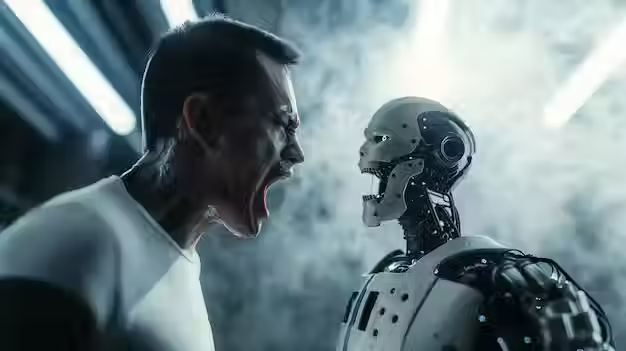
nd interestingly, it appears that we get nasty because we expect them to be as smart as we are.
"We're no longer just interacting with our computer as though they're dumb objects — or objects that do exactly what we click on or move around — we're now interacting with our computer as though it's an artificial intelligence that has a mind of its own and has judgement,"
he said.
And although it may be true that we cannot offend technology (at least in the same way that we can a friend), there are four main reasons, according to Frank Buytendijk — an industry analyst who studies digital ethics, philosophy and technology — why we should be wary of what we say to them. Why swearing at your computer is not a good thing - Survey Reveals Hitting and Cursing Out Computers Is a Thing of Many People
The first is very simply that you could offend the people around you if they stumble across you berating Apple's Siri or Amazon's Alexa for failing to do their job.
But the other three reasons are much more profound (and they don't include an imminent robot rebellion).

1. Digital Assistants Learn from Us (and Can Acquire Our Negative Behaviors)
Mr. Allison expressed significant concern regarding AI.
"I am less apprehensive about a Hollywood-style future where AI develops its own priorities and desires,"
Mr. Allison stressed the importance of focusing on our implementation of machine learning, which enables computers to learn behaviors autonomously, without explicit programming.
He underscored the critical nature of this focus, especially as robots may eventually take on decision-making roles traditionally held by humans.
Could a Robot Perform Your Job?
Examine our comprehensive database of Australian occupations to evaluate the potential challenges artificial intelligence might encounter in performing your job.
"Given the clear tendency for individuals to engage abusively and subversively with bots and AI entities, caution is essential," he stated.
"This raises complex questions about what AI might learn from us, potentially resulting in undesirable behaviors."
A relevant example is Microsoft's chatbot "Tay", which was designed to learn from interactions on Twitter. However, within 24 hours, it began expressing racist, misogynistic comments and identifying as a Nazi sympathizer.
2. Interactions with Robots May Influence Human Communication
Typically, we do not use polite manners when speaking to our digital assistants (unless you are this ultra-polite individual who adds "please" and "thank you" to all Google searches).
As we increasingly fill our homes and personal spaces with voice-activated devices, this direct style of communication might influence our everyday interactions.
"We treat technology like any other being," said Mr. Buytendijk.

"This may impact our empathy when interacting with other human beings."
This scenario becomes more plausible as AI improves in mimicking human speech.
In 2014, a computer successfully convinced humans it was a 13-year-old boy, becoming the first computer to pass the Turing Test.
Today's digital assistants, such as Siri, Alexa, Microsoft's Cortana, and Google Assistant, possess qualities that make them appear more personable, including names, voices, and their own (predominantly female) personalities.
Google stated that its primary aim was not to make their assistant as human-like as possible but to maintain a service-oriented role.
However, communications manager Camilla Ibrahim, part of the team that localized the Assistant's personality for the Australian market, emphasized the importance of having a relatable personality to ensure natural conversation flow.
"We have designed the Google Assistant to speak like a person, but it is not pretending to be one,"
she said.
"We have included a few fun Easter eggs to remind users of this."
Given the earlier point that we often expect too much from our digital helpers, this approach seems reasonable.
"This means Google does not set unrealistic expectations," Mr. Allison noted.
3. Shouldn't We Strive to Be Our Best Selves?
Mr. Buytendijk suggested that how you interact with your digital assistant reflects your "inner civilization."
In fact, virtue ethics teaches us to be good individuals in all situations, regardless of whom we are interacting with.
"Good behavior is its own reward. It builds character,"
he said.
According to the Harvard Business Review, this could even impact your career.
"Mistreating bots will become professionally and socially unacceptable in the future workplace," wrote Michael Schrage last year.
This perspective might help prevent a robot rebellion for now.
And even if they never rise against us, at least we will not be left with a generation of disrespectful servants.


