
Running Your Own Bitcoin Node: Who Needs One, and When It Pays Off
Running Your Own Bitcoin Node: Who Needs One, and When It Pays Off
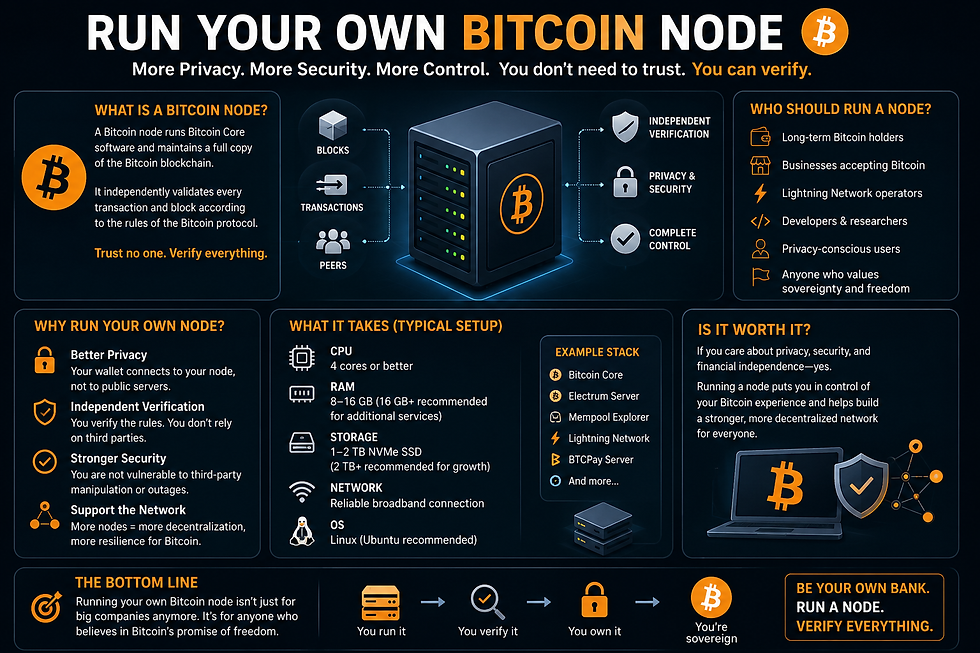
Bitcoin was designed to operate without relying on banks, governments, or third parties. Running your own Bitcoin node is one of the best ways to participate in that vision. A node independently verifies every transaction and every block on the Bitcoin network, allowing you to trust your own system rather than someone else's.
While millions of people own Bitcoin without operating a node, there are many situations where running one offers significant advantages.
What Is a Bitcoin Node?
A Bitcoin node is a computer running Bitcoin Core software that downloads and verifies the entire Bitcoin blockchain. Instead of trusting a wallet provider or exchange, your node independently confirms that transactions follow the Bitcoin protocol.
Unlike Bitcoin mining, a node does not earn Bitcoin. Its purpose is to improve privacy, security, decentralization, and trust.
Who Should Run a Bitcoin Node?
Long-Term Bitcoin Investors
If you hold Bitcoin as a long-term investment, operating your own node lets you verify your balance and transactions without relying on third-party services. It provides greater confidence that your Bitcoin is genuine and securely recorded on the blockchain.
Businesses Accepting Bitcoin
Businesses that receive Bitcoin payments can independently verify transactions without trusting external payment processors. This reduces dependence on third-party infrastructure and improves transaction reliability.
Developers
Developers building Bitcoin applications, wallets, payment systems, or blockchain services benefit from direct access to blockchain data. A local node provides faster, more reliable access for testing, development, and research.
Privacy-Focused Users
Many wallets query public servers for balances and transaction history, which can reveal information about your wallet. Connecting your wallet to your own node keeps that information private and significantly reduces data sharing.
Lightning Network Users
Anyone operating a Lightning Network node should also operate a Bitcoin full node. The Lightning Network depends on a trusted local Bitcoin node to monitor channels and validate transactions.
Researchers and Educators
Universities, blockchain researchers, and educators often use Bitcoin nodes to analyse blockchain activity, demonstrate Bitcoin's operation, and conduct network research.
When Does Running a Node Pay Off?
Running a node doesn't generate income, but it delivers value in several important ways.
Improved Privacy
Your wallet communicates directly with your own server instead of public blockchain explorers or wallet providers.
Independent Verification
You no longer have to trust an exchange, wallet company, or blockchain website. Your node independently verifies every transaction.
Greater Security
A compromised website or wallet service cannot mislead your node into accepting invalid blockchain data.
Support for the Bitcoin Network
Every additional node strengthens Bitcoin's decentralization and resilience by helping distribute verified blockchain data across the network.
Foundation for Self-Hosting
A Bitcoin node can become the centre of a larger self-hosted infrastructure, including:
Electrum Server
Mempool Explorer
Lightning Network
BTCPay Server
Personal cloud storage
Automated backup systems
Research archives
Family document storage
Is It Worth It?
A Bitcoin node is most worthwhile if you:
Own a meaningful amount of Bitcoin.
Value privacy and financial independence.
Want complete control over transaction verification.
Plan to use the Lightning Network.
Enjoy self-hosting technology.
Want to contribute to Bitcoin's decentralization.
If you only purchase small amounts of Bitcoin occasionally through an exchange, running a node may not provide immediate practical benefits. However, as your involvement with Bitcoin grows, the advantages become increasingly valuable.
Hardware Requirements
Modern Bitcoin nodes benefit from reliable hardware. A typical setup includes:
Quad-core or better processor
16 GB RAM (32 GB recommended if running additional services)
2 TB NVMe SSD (4 TB recommended for long-term growth)
Gigabit Ethernet connection
Reliable UPS (Uninterruptible Power Supply)
Linux operating system for maximum stability
Many enthusiasts combine their Bitcoin node with additional services such as Electrum Server, Mempool, Nextcloud, and automated backup systems, creating a secure and private home server.
Final Thoughts
Running your own Bitcoin node is about more than simply downloading the blockchain. It is about verifying Bitcoin on your own terms, improving privacy, strengthening network decentralization, and building a self-hosted infrastructure that you fully control.
As Bitcoin adoption continues to grow, operating a personal node remains one of the most effective ways to participate directly in the network while reducing dependence on third parties.
Running your own Bitcoin node has traditionally required a significant investment of time and technical expertise. Setting up suitable hardware, installing Bitcoin Core, enabling features such as txindex, waiting for the initial blockchain download to complete, configuring monitoring tools, and maintaining the node through every software update all formed part of the process. Organisations with mission-critical Bitcoin infrastructure accepted this workload because the benefits of independently verifying transactions, controlling transaction broadcasts, and maintaining full visibility of the mempool outweighed the ongoing maintenance.
Running Your Own Bitcoin Node: Who Needs One, and When It Pays Off
Today, that equation is changing. Bitcoin Core itself has long been recognised as reliable, mature, and relatively straightforward to operate. The real complexity has typically come from the surrounding infrastructure—deployment, monitoring, automated recovery, software updates, backups, and high availability. Modern self-hosted management platforms now simplify many of these operational tasks, allowing users to focus on running a secure Bitcoin node instead of building and maintaining the supporting infrastructure from scratch.
Whether you're an individual Bitcoin enthusiast, a business accepting Bitcoin payments, or an organisation developing blockchain applications, running your own node offers greater privacy, security, and independence. Understanding who benefits most, what day-to-day operation involves, and how today's deployment options compare with traditional manual installations can help determine whether hosting your own Bitcoin node is the right choice.
Who Runs Their Own Bitcoin Node, and Why?
Running a Bitcoin node isn't just for developers or cryptocurrency enthusiasts. Many of the world's largest Bitcoin organisations, financial institutions, and technology companies rely on their own nodes because they provide greater security, privacy, reliability, and complete control over blockchain data.
Bitcoin Payment Processors
Companies that process Bitcoin payments operate their own nodes to independently verify transactions and monitor the network in real time. By broadcasting transactions directly from their own infrastructure, they maintain greater control over transaction propagation, improve fee estimation, detect potential double-spend attempts more quickly, and reduce their dependence on external service providers. For businesses that handle thousands of Bitcoin payments, running their own node is an essential part of delivering a reliable payment service.
Cryptocurrency Exchanges and Digital Asset Custodians
Major cryptocurrency exchanges and institutional custodians maintain multiple Bitcoin nodes to independently validate customer deposits, withdrawals, and wallet balances. Operating their own infrastructure improves security, supports regulatory compliance, and allows them to verify blockchain activity without relying on third-party APIs. As transaction volumes increase, self-hosted nodes also provide the scalability and performance required to manage millions of wallet addresses and blockchain queries efficiently.
Lightning Network Operators
Every Lightning Network implementation depends on a Bitcoin full node. Whether operating a personal Lightning wallet or a large routing node, the Lightning software requires direct access to Bitcoin Core for blockchain verification, transaction monitoring, and channel management. Running a Bitcoin node is therefore a fundamental requirement for anyone participating in the Lightning Network.
Blockchain Explorers and Data Providers
Blockchain explorers, blockchain analytics companies, and research organisations rely on full Bitcoin nodes to provide accurate, real-time blockchain information. These organisations often operate multiple nodes alongside specialised indexing services to deliver transaction searches, address lookups, blockchain statistics, and network analytics with high availability and redundancy.
Trading Firms and OTC Desks
Professional trading firms and over-the-counter (OTC) Bitcoin brokers benefit from immediate access to mempool data and direct transaction broadcasting. Having their own node allows them to monitor network conditions as they happen, optimise transaction fees, and react quickly to changing market activity without introducing delays caused by third-party services.
Institutional Investors and Corporate Treasury Teams
Large organisations holding significant Bitcoin reserves frequently operate their own nodes as part of their security and governance strategy. Independent verification of wallet balances and blockchain activity reduces reliance on external providers while improving operational confidence, auditability, and long-term control over digital assets.
Why It Matters
Regardless of the organisation's size, the reasons for running a Bitcoin node are remarkably consistent. Self-hosting provides complete control over blockchain verification, improves privacy by removing reliance on external services, delivers faster access to real-time network information, enhances security, and supports long-term operational independence.
As Bitcoin adoption continues to grow, running a personal or business Bitcoin node is becoming increasingly common—not only among cryptocurrency companies, but also for businesses, developers, researchers, and individuals who value transparency, privacy, and complete ownership of their Bitcoin infrastructure.
Running Your Own Bitcoin Node: Who Needs One, and When It Pays Off
Audience | Use case | What your own node unlocks | Examples |
Payment processors | Accept BTC payments reliably at scale | Controllable broadcast, real-time double-spend detection, mempool-accurate fee estimation | BitPay, Strike, OpenNode, NOWPayments |
Exchanges & custodians | Custody customer BTC, generate fresh addresses at scale | Audit-grade infrastructure control, rate limits that hold at exchange scale | Coinbase, Kraken, BitGo, Anchorage |
Lightning Network operators | Run production LN routing or channel nodes | Direct Bitcoin Core RPC, ZMQ feed, txindex enabled (required, not optional) | LND, Core Lightning, Eclair |
Block explorers & analytics | Serve Bitcoin data as a product | Multi-node redundancy, custom indexer feeds, full historical access | Mempool.space, blockstream.info, Chainalysis |
OTC desks & HFT | Latency-sensitive arbitrage and broadcast | Sub-100ms mempool propagation, controllable broadcast path | OTC desks, market makers, prop trading firms |
Treasury & ETF custodians | Independent verification of large BTC holdings | Audit-defensible chain of trust without a third-party intermediary | Coinbase Custody, Fidelity Digital Assets, BitGo |
Why Businesses Choose to Run Their Own Bitcoin Node
The common thread across every organisation that operates its own Bitcoin node is simple: when Bitcoin plays a critical role in your business—whether it's processing payments, safeguarding customer assets, supporting the Lightning Network, analysing blockchain data, or managing corporate investments—you want complete control over your infrastructure rather than relying on third-party services.
Owning your own node means you independently verify every transaction, maintain direct access to blockchain data, improve privacy, and reduce the operational risks associated with external providers.
What Does It Cost to Run a Bitcoin Node?
While operating a Bitcoin node is far easier today than it was just a few years ago, there are still some practical considerations. Fortunately, the costs are relatively predictable and easy to plan for.
Initial Blockchain Synchronisation
Before a Bitcoin node can fully participate in the network, it must download and verify the entire blockchain. As of 2026, the Bitcoin blockchain occupies approximately 750 GB of storage and continues to grow by around 70–90 GB each year.
Depending on your hardware and internet connection, the initial synchronisation can take anywhere from several hours to several days. Modern versions of Bitcoin Core support technologies such as AssumeUTXO, allowing many users to dramatically reduce setup time by bootstrapping from a verified blockchain snapshot before completing the remaining validation.
Storage Requirements
Bitcoin's blockchain grows steadily over time, making storage planning straightforward.
For most users:
1 TB NVMe SSD is suitable for a dedicated Bitcoin node with room for future growth.
2 TB NVMe SSD is recommended if you plan to run additional services such as Electrum Server, Mempool, Lightning Network software, or simply want several years of storage capacity without upgrading.
Pruned nodes can significantly reduce storage usage by deleting older blocks after verification. However, pruning also removes access to historical blockchain data and is unsuitable for applications that require transaction indexing (txindex), Lightning Network infrastructure, or blockchain research.
Software Updates
Bitcoin Core is renowned for its stability and typically releases major updates only a few times each year, with occasional security patches released when necessary.
Keeping your node updated ensures compatibility with new protocol improvements, security enhancements, wallet features, network policy changes, and future Bitcoin upgrades. While updates are generally infrequent, regular maintenance remains an important part of operating a secure and reliable node.
Monitoring and Reliability
Like any server, a Bitcoin node benefits from ongoing monitoring.
Storage devices can fill over time, internet connections may become unstable, peer connectivity can change, and unexpected hardware issues can occur. Monitoring tools help identify these problems before they affect your applications, allowing you to maintain continuous operation and minimise downtime.
For businesses relying on Bitcoin infrastructure, proactive monitoring is essential to ensure consistent performance and reliability.
Can You Simply Set It and Forget It?
Many personal Bitcoin nodes run for months—or even years—with very little attention. For hobbyists, this is often perfectly acceptable.
Business environments, however, have different expectations. Production systems require regular software updates, security maintenance, backups, hardware health checks, and ongoing monitoring to ensure they remain synchronised with the Bitcoin network and continue operating reliably.
A well-maintained node provides dependable performance and long-term security, making it a valuable asset for organisations that rely on Bitcoin every day.
The Bottom Line
Running a Bitcoin node is no longer a complex engineering project reserved for large organisations. With modern hardware, faster storage, improved software, and better management tools, operating a secure and reliable Bitcoin node has become practical for businesses, developers, researchers, and individual Bitcoin users alike.
The investment is modest compared to the benefits: greater privacy, complete control over transaction verification, independent access to blockchain data, and the confidence that comes from verifying the Bitcoin network on your own infrastructure.
What Has Changed? Running a Bitcoin Node Is Simpler Than Ever
For many years, operating a Bitcoin node meant doing everything yourself. Beyond installing Bitcoin Core, you also needed to build and maintain the supporting infrastructure—provisioning hardware, configuring the operating system, managing software updates, monitoring performance, creating backup strategies, and ensuring the node remained online and fully synchronised.
Today, modern deployment and management platforms have significantly simplified this process.
Rather than spending time building and maintaining the operational environment, users can focus on what matters most—running a secure, independently verified Bitcoin node on infrastructure they own and control. Automated deployment, blockchain snapshots to reduce initial synchronisation times, health monitoring, self-healing capabilities, software updates, and performance dashboards have transformed what was once a complex infrastructure project into a far more manageable task.
Another advantage is that Bitcoin Core remains one of the most resource-efficient blockchain clients available. A dedicated Bitcoin node can comfortably run on modest modern hardware, typically requiring:
4 CPU cores or better
8 GB of RAM (16 GB recommended if running additional services)
1 TB or larger NVMe SSD
Reliable broadband internet connection
Fast NVMe storage is strongly recommended because it dramatically improves blockchain synchronisation, database performance, and transaction processing compared with traditional hard drives or SATA-based SSDs.
Many modern deployments also enable txindex by default, allowing historical transaction lookups, blockchain indexing, Lightning Network compatibility, and integration with applications such as Electrum Server, Mempool Explorer, and blockchain analytics tools without requiring additional configuration or a lengthy re-synchronisation later.
The result is that running a Bitcoin node is no longer reserved for large organisations with dedicated infrastructure teams. Businesses, developers, researchers, and individual Bitcoin users can now deploy reliable, production-ready Bitcoin nodes more quickly than ever while retaining complete ownership and control of their infrastructure.
Whether your goal is improving privacy, supporting Bitcoin applications, operating a Lightning Network node, or simply verifying the blockchain independently, today's tools have made self-hosting considerably more accessible than it was only a few years ago.
Snapshot-assisted deployment significantly reduces the initial sync window — Chainstack’s Bolt is the patented snapshot tech behind the platform’s managed Bitcoin nodes, and the same operational thinking informs how Self-Hosted deployments come online quickly without genesis-up resyncs. The self-healing and auto-update layers handle the operational discipline most self-hosted setups quietly skip. Failover lets you route to a Chainstack-managed Bitcoin endpoint if your own node has issues, so you’re not choosing between “own infrastructure” and “production reliability” — you get both.
You still own the node. The data never leaves your perimeter. You can SSH into the box and run bitcoin-cli against it like any other Bitcoin Core install. The difference is you didn’t build the deployment and operational stack around it yourself.
When to self-host Bitcoin, and when not to
The decision isn’t religious. It’s a workload question.
Run your own Bitcoin node if:
You’re accepting BTC payments in production. The fee estimation, double-spend detection, and broadcast reliability arguments compound until they’re decisive.
You hold customer Bitcoin or BTC at corporate-treasury scale.
You run a Lightning Network node of any meaningful size. (Required, not optional.)
Your application makes more than a few hundred thousand RPC calls per day. Managed RPC pricing scales with call volume; your own node runs at a flat hardware cost regardless of throughput.
You need ZMQ subscriptions, full mempool access, or txindex-dependent features.
Compliance, audit, or regulatory frameworks require infrastructure control.
Reach for managed Chainstack Bitcoin instead if:
You’re learning, prototyping, or running a low-volume side project. Chainstack Global Nodes with a free Developer tier covers most of that scale without the setup.
You only need historical lookups (a single block explorer API call now and then). Pay-per-call access through Chainstack’s Bitcoin tier is cheaper than running a full node for that pattern.
You’re doing read-only analytics and the data is non-critical.
The middle ground — production workloads that wanted their own Bitcoin node without committing to a full DIY setup — used to have no clean answer. DIY self-hosting worked, but the setup and monitoring stack around Bitcoin Core was itself a quarter of DevOps work. Chainstack Self-Hosted is what removes that barrier: your infrastructure, none of the setup marathon.
If your Bitcoin workload is heading toward “load-bearing for the business,” running your own node was always the right answer. What’s new is that the path from “I should probably do this” to “it’s deployed and monitored” doesn’t have to take a quarter anymore.
Frequently Asked Questions
How long does it take to synchronise a Bitcoin node?
The initial synchronisation depends on your hardware, internet connection, and whether you're starting from scratch. Downloading and verifying the entire Bitcoin blockchain can take anywhere from several hours to several days.
Many modern deployments use verified blockchain snapshots, such as AssumeUTXO, to significantly reduce the initial setup time while still allowing the node to complete full verification.
Can I run a pruned Bitcoin node to save storage space?
Yes. Bitcoin Core supports pruned mode, which removes older block data after it has been verified, dramatically reducing storage requirements.
However, pruned nodes are not suitable for every use case. Features such as historical transaction indexing (txindex), many Lightning Network deployments, blockchain explorers, and analytics platforms generally require a full, non-pruned node.
If your goal is simply to verify your own transactions and contribute to the Bitcoin network, a pruned node may be sufficient.
Can I use my Bitcoin node with the Lightning Network?
Yes. Every Lightning Network implementation, including LND, Core Lightning, and Eclair, relies on a Bitcoin full node to verify blockchain activity and manage payment channels.
For the best compatibility and functionality, most Lightning deployments are configured with a full Bitcoin node that has transaction indexing (txindex) enabled.
How much storage does a Bitcoin node require?
As of 2026, the Bitcoin blockchain occupies approximately 750 GB and continues to grow by around 70 to 90 GB per year.
For most users, a 1 TB NVMe SSD provides sufficient capacity for a dedicated Bitcoin node. If you plan to run additional services such as Electrum Server, Mempool Explorer, or Lightning software, a 2 TB NVMe SSD is generally recommended.
What hardware is recommended?
A typical Bitcoin node performs well with:
Quad-core processor or better
8 GB RAM minimum (16 GB recommended for additional services)
1 TB or larger NVMe SSD
Reliable broadband internet connection
Linux operating system for maximum stability
Bitcoin Core has relatively modest hardware requirements compared with many other blockchain platforms.
What happens if my Bitcoin node goes offline?
If your node loses power, internet connectivity, or experiences a hardware failure, it will simply reconnect and continue synchronising with the Bitcoin network once it is back online.
For business or production environments, monitoring, automated backups, and redundancy are recommended to minimise downtime and ensure continuous availability.
Do I need to keep my Bitcoin node updated?
Yes. Although Bitcoin Core is extremely stable, new versions include security improvements, bug fixes, performance enhancements, and support for future network upgrades.
Keeping your node updated helps maintain security, compatibility, and reliable operation over the long term.
Does running a Bitcoin node earn Bitcoin?
No. Running a Bitcoin full node does not generate mining rewards or transaction fees.
Instead, the benefits come from independently verifying the blockchain, improving privacy, supporting network decentralisation, and maintaining complete control over your own Bitcoin infrastructure.
Is running a Bitcoin node worth it?
For casual Bitcoin users, operating a node is optional. However, if you regularly use Bitcoin, value privacy, operate a Lightning Network node, accept Bitcoin payments, develop Bitcoin applications, or simply want to verify the blockchain yourself, running your own node provides greater security, independence, and control.
Many businesses and long-term Bitcoin holders consider operating their own node an important part of protecting their digital assets.
Additional resources
Chainstack Self-Hosted documentation:
